
Propaganda
Mandarin | Japanese | French | Spanish | Spanish | Italian | Korean | Russian
|
Depending on where you come from you can approach vvvv in different ways. The following provides an overview of vvvvs main capabilities and features conveniently grouped by buzzwords. |
vvvv is your favorite multipurpose toolkit. |
Hybrid Visual/Textual Development Environment
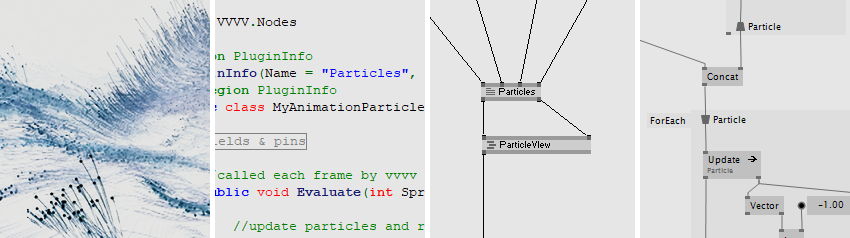
Above all vvvv is targeted at the lazy developer and offers four things in one:
Besides its own visual language, the environment is also host to our new visual language VL and the two textual languages hlsl and c#. |
Regardless of the language used, vvvv knows only one mode: runtime. Thus turning the notion of stopping a program to recompile it into a footnote of the early days of programming. Where necessary compilation happens behind the scenes and doesn't interrupt your flow of work.
Extending vvvv with your own nodes is a breeze, see developing plugins. In fact many parts of vvvvs node library are contributed by users via the addonpack and Contributions. |
2D/3D Animation Interactive realtime 2d/3d animated cyber particles. vvvv has it all. Featuring 3 distinct fully blown industry standard rendering engines Entry points: |
Multiscreen Setups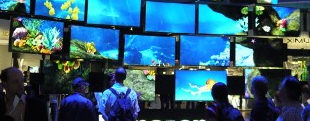 Designed from the ground up to handle massive multiprojection installations vvvv drastically lightens the effort involved in such setups. Using a technique dubbed boygrouping™ you can make a cluster of client PCs render to the beat of a server PC and distribute content to them n'sync. Synchronized video playback, softedge, warping and blending are all just limited by your imagination. Entry points: |
Motion Graphics Loving the likes of Photoshop and AfterEffects but loathing their rendering times and lack of interactivity? vvvv is just for you. With its plethora of professional grade texture effects* and a timeline that has no rival you shop your compositions at any resolution. In realtime. Entry points: |
Projection Mapping Need to project on an irregular surface while preserving the intrinsic shape of your content? By providing tools that let you load/create meshes resembling your projection surface and ways to place textures on them vvvv is extremely versatile when it comes to the needs of any projectionist. Entry points: |
Data Visualisation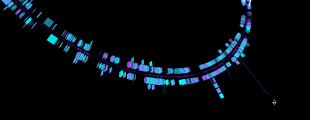 Need to get a better view on endless lists of data? vvvv is a pro in helping you do just that. Read from disk, database (MySQL, PostgreSQL/SQLite/SQL/Odbc/OleDb*) or the network (HTTP, UDP,..), parse (xml, json, csv, regexpr,...), transform and draw (SVG, DirectX) large amounts of data with just a few clicks. Export your visualisations as vector graphics, still images, movies or just lists of even more data. With its paradigm called spreads™ vvvv makes it a childs play to handle large amounts of data. Entry points: |
Physical Computing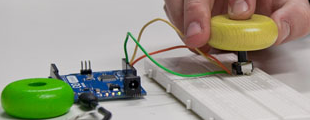 Wii*, Leap, Kinect*, Oculus Rift*, Arduino*,... vvvv does them all. And even more by offering readers/writers for most common standard protocols like MIDI, OSC, TUIO, DMX, HTTP, TCP, UDP to name only the hottest. Plug and Play at its finest. And also multitouch. Entry points: |
Sound Multichannel audio playback, FFT analysis, ASIO and whatnot. While vvvvs audiocapabilities can not compete with the likes of PD and MaxMSP it covers a wide range of applications that you'll come across in your daily multimedia needs. Entry points: |
Computer Vision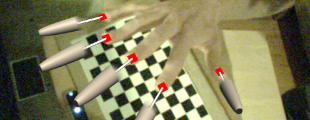 Motion and face detection, color, blob, face and skeleton tracking, gesture recognition... you choose. With easy access to devices like the Kinect* and the Leap and libraries like OpenCV* vvvv is your perfect companion when it comes to quickly prototyping computer vision applications. Entry points: |
* several parts of vvvvs node/code library are user contributed:
vux: DirectX11 (via DX11 pack), Box2d, Bullet, Bass, PostgreSQL, SQLite, SQL, Odbc, OleDb (via addonpack)
elliotwoods: OpenCV (via ImagePack)
unc, lecloneur: texture effects (via addonpack)
woei: advanced spread operations (via addonpack), GPU splines (via contributions)
dottore: MRE - Multipass Render Engine (via contributions)
These are only the biggest contributors, many more are contributing smaller bits.
You might also want to check the Galleria to get an impression of what people do with vvvv.
anonymous user login

Shoutbox
~4d ago
~4d ago
~8d ago
~16d ago
~24d ago
~1mth ago
~1mth ago
~2mth ago