
This site relies heavily on Javascript. You should enable it if you want the full experience. Learn more.
Creating Feedback Loops
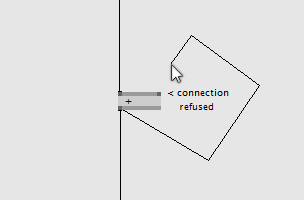 |
If vvvv does not allow you to create a connection between two pins that would normally be connectable because they have the same datatype, this is most likely because the link would create a loop in the graph. Creating a loop is not a valid connection! |
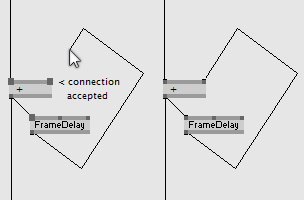 |
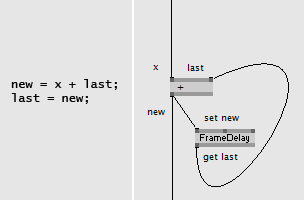
SolutionUse a FrameDelay (Animation) (or another suitable for your datatype) in the loop to be able to close it. The framedelay is essentially breaking the loop in that its output is not depending on its input of the same frame but simply returns the value the input had in the last frame. |
anonymous user login

Shoutbox
~8d ago
joreg:
Postponed: Next vvvv beginner course starting April 29: https://thenodeinstitute.org/courses/vvvv-beginner-class-summer-2024/
~15d ago
joreg:
vvvv gamma 6.0 is out: https://visualprogramming.net/blog/2024/vvvv-gamma-6.0-release/
~1mth ago
~1mth ago
joreg:
Next vvvv beginner course starting April 15: https://thenodeinstitute.org/courses/vvvv-beginner-class-summer-2024/
~1mth ago
joreg:
The Winter Season of vvvv workshops is now over but all recordings are still available for purchase: https://thenodeinstitute.org/ws23-vvvv-intermediates/
~1mth ago
schlonzo:
Love the new drag and drop functionality for links in latest previews!
~2mth ago
joreg:
Workshop on 29 02: Create Sequencers and Precise Clock Based Tools. Signup here: https://thenodeinstitute.org/courses/ws23-vvvv-08-create-sequencers-and-precise-clock-based-tools-in-vvvv-gamma/
~2mth ago
joreg:
Workshop on 22 02: Unlocking Shader Artistry: A Journey through ‘The Book of Shaders’ with FUSE. Signup here: https://thenodeinstitute.org/courses/ws23-vvvv-12-book-of-shaders/